
Lucas County Most Wanted Availability
Lucas County has no public Sheriff's most-wanted list with photos right now. There is no verified roster of names from the agency, no set count, and no published update schedule. That does not mean the county is out of warrants. The Sheriff simply has not put out that kind of list for the public.
The Lucas County Sheriff's Office site offers general services plus a registered sex-offender search. That search is not a most-wanted roster, and calling it one would mislead readers. No official Warrant Wednesday feature exists either. A name shared on social media or reposted from an unofficial page cannot stand in, since a wanted notice can change fast and only the issuing agency can vouch for it.
What Lucas County Wanted Listings Show
With no official listing to pull from, there are no fields to report. The details below only matter if the Sheriff later publishes a verified wanted notice. Each piece of information would carry its own source date. Any photo shown would stay on the government site rather than being copied into a gallery here.
| Possible official field | What to verify before relying on it |
|---|---|
| Name and identifying details | Whether the notice gives enough information to distinguish people with similar names. |
| Photograph | Whether an image is actually published by the Sheriff and the date it was posted or refreshed. |
| Warrant or case basis | The issuing court, case number, and precise warrant-related language, not a shortened retelling. |
| Issue or update date | The date of the notice, because a page without a current date does not establish present status. |
| Contact instructions | The agency-approved method for providing information, including any emergency direction stated by the source. |
A wanted list shows where a case stands at one moment. That is all. Courts can change the charges later, drop a count, accept a plea, or reach a verdict after the listing went up. The final outcome lives in a separate court record. Booking language and notice wording never settle the matter by themselves.
Using a Lucas County Wanted List
If the Sheriff publishes an official list down the road, check that it sits on a verified agency page. Look for a current date or a stated update. Save the link and the notice date before trusting it as fresh. And resist substitutes. A nearby agency's list, a general community alert, or a sex-offender search is not a Lucas County wanted notice.
- Check the official agency identity, the page address, and any date or update statement before reading a listing.
- Match the notice’s name and case or warrant details against the issuing court, rather than relying on a photograph or name alone.
- If a person is taken into county custody, use the Lucas County booking-record path to distinguish the later intake record from the earlier wanted notice.
- Send a tip only through the listed law-enforcement channel. Do not make contact with the person or try to resolve the matter yourself.
A wanted list helps only if the Sheriff's Office spells out what it holds. Fields, photos, and reporting steps should come from the agency itself. Anything rebuilt from other sources invites errors. Skip the patched-together roster of names and go through the official court confirmation route instead.
Note: A booking after an arrest shows a new custody event, but it cannot confirm the earlier warrant language or how the case ends up.
Lucas County Crime Stoppers Tips
Toledo Crime Stoppers takes anonymous tips about unsolved crime in Lucas County. The line runs around the clock. Calls and texts both work at 419-255-1111. Rewards can reach $5,000 for eligible information in a felony investigation that leads to an arrest, though the program judges each case on its own terms. Remember, it takes tips, not warrant checks.
Toledo Crime Stoppers
Information about unsolved crime in Lucas County
Call or text: 419-255-1111
The tip line answers 24 hours a day. Information that helps a felony investigation and leads to an arrest may earn a reward of up to $5,000.
The official Crime Stoppers contact page identifies the tip and reward channel.
Crime Stoppers is for sharing what you know. It does not verify docket entries. If a warrant might involve you, skip the tip line. Call the issuing court or talk to an attorney instead.
Check Lucas County Warrant Status
Want to know if a Lucas County warrant exists? There is no countywide public search tool for Sheriff warrants. The Sheriff does publish a Validation of Warrants and Protection Orders policy, but it is not a lookup form. The document explains how deputies work with LEADS data, the agency that issued the warrant, and the clerk tied to it. One more distinction matters. Asking for a copy of an existing record is not the same as asking staff to make a fresh legal call on whether a warrant stands.
- Identify the likely issuing court from any case paper, docket number, arrest record, or court field available to you.
- For Common Pleas matters, check the Lucas County Common Pleas Court and the Clerk of Courts Case Information path.
- For Toledo criminal or traffic matters, check the Toledo Municipal Court criminal and traffic search.
- Compare the name, case number, court, and event date, then ask the issuing clerk to confirm current status. An old docket event alone is not confirmation.
- When the question concerns your own record, seek advice from an attorney or contact the issuing court to resolve it safely.
Which court you ask matters a great deal. Toledo cases usually run through Toledo Municipal Court, while Oregon, Sylvania, and other suburbs may fall under their own municipal courts. When a county booking record is on hand, the LCCC court field can point the inquiry toward the right bench.
Online case files help you find a matter. They do not settle it. Common Pleas entries can show up before anything is signed and journalized, and details can shift after a warrant event. Keep the court, case number, and date ready when you contact the clerk. If no public disposition shows up, that gap alone does not close the case.
Lucas County Warrant Court Search
For a court-based route, Toledo Municipal Court's official criminal and traffic search can help spot a case before the clerk confirms it. Keep the case date and court name in view as you search. This tool covers one court, not a countywide warrant index.
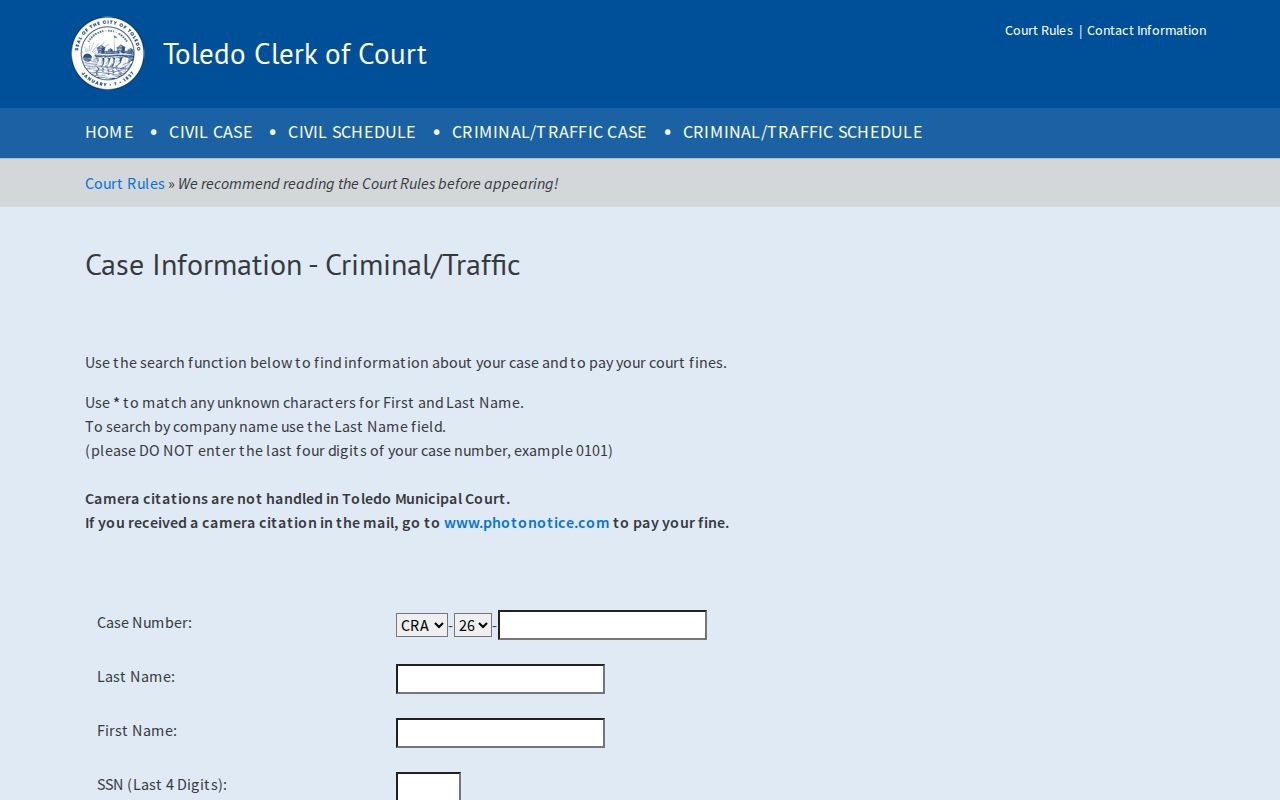
Want to know if a warrant is still active? Ask the issuing court or its clerk. That office gives the only reliable answer on current status. The court interface, for its part, helps you find a case file. One catch: older entries linger. A past capias or failure-to-appear can stay visible in the record even after the matter behind it was resolved.
Lucas County Warrant Types
Warrant labels come from court process. Ohio has no single statewide public list. The name on a warrant and what it means right now both trace back to the issuing court. The categories described here reflect common record language. They show how clerks and deputies tend to phrase things. They cannot tell you whether any one person has an active warrant, and they do not cover every court's habits.
| Record term | Careful reading |
|---|---|
| Arrest warrant | A court-process order that may authorize an arrest in connection with an charge. It is not a finding of guilt. |
| Bench warrant | A court-issued warrant often associated with a required court appearance or compliance issue. The docket and clerk provide the specific basis. |
| Capias or warrant-related event | A docket term that can signal warrant-related action. Its appearance on an older docket does not prove that it remains active. |
A category is not a conclusion. Plenty of warrant-related events lead somewhere else entirely: an appearance, a recall, a transfer, or some other case action. The only way to know a warrant's present status is a current response from the issuing court or clerk.
Lucas County Warrant Validation Timing
Sheriff policy lays out a monthly LEADS validation list. Records staff compare warrant and protection-order details against the issuing clerks' files. That routine explains why timing matters. Entries get corrected, updated, or resolved after first appearing online. Yesterday's search result may not match today's record. The policy itself builds no public database, and it cannot replace confirmation from the court that issued the matter. A clerk comparison counts most when a docket holds an older capias or failure-to-appear entry that may no longer hold true.
The Sheriff's office offers no dedicated app for inmate lookup, booking photos, or warrant status. The electronic Booking Summary lives on the web as a page or PDF rather than an app. No steady Sheriff social-media source of booking photos checks out either. County alert systems are not warrant feeds. If a search turns up nothing online, treat that gap as a prompt to call the right official office, not as a final answer.